Design, validate, refine SDV architectures. End to end.
When developing SDV architectures, an end‑to‑end approach is needed to bring development and validation together. Variants evolve iteratively, remain traceable, and can be advanced in a targeted way. This creates a predictable path from a demonstrator to a scalable solution.
Intelligent placement of software modules and network configuration powered by AI.

The hardware changes. The software stays.
OSxCAR develops an open platform that enables execution of the same software binary across CPU, GPU, and microcontroller — from testing to production.
One Binary for Every Target
From simulation to vehicle — on CPU, GPU, and microcontroller. Unchanged.
No recompilation. No adaptation. One software base for every target platform.
Software as a Product
Build once. Deploy everywhere.
Versioned, modular, with stable interfaces — integrable without vendor lock-in.
Speed & Efficiency
Minutes instead of months.
Test environments available instantly. Less effort, lower cost, faster results.
Safety & Compliance
What's tested runs in production.
Consistent execution across the entire lifecycle — for functional safety and cybersecurity.
Based on open standards such as WebAssembly and W3C. Independent of hardware, operating system, and processor architecture — usable from vehicles to industries like robotics, avionics, and medical technology.
A new approach to vehicle software
Today
Software is adapted for each target platform.
With OSxCAR
One binary runs from simulation to vehicle — no porting, no recompilation.
SimulationModel and validate functions
TestAutomated validation on virtual and real hardware
VehicleIdentical binary in the control unit
CloudSame modules for updates and operations
What works in simulation works identically in the vehicle.
The project evolves continuously — from new demonstrators to scientific publications.
Neuigkeiten
OSxCAR Consortium Meeting: Halfway There and on Track
At the end of April 2026, the partners of the publicly funded OSxCAR project met for a two-day consortium meeting in Wuppertal. The focus was on reviewing the current project status and aligning on the next technical steps.
At the project midpoint, OSxCAR has made solid progress overall: The system architecture for software-defined vehicle platforms is in place, first WebAssembly-based demonstrators have been implemented, and key components of the SDV testbench — including the reconfigurable switch matrix — are currently being integrated and validated. In parallel, work continues on a hardware-independent test framework and AI-assisted methods for network optimization.
The meeting was hands-on and work-focused. Alongside brief status updates from all partners, technical details were discussed in depth — particularly around hardware-software integration, test automation, and the preparation of upcoming demonstrations.
The consortium is confident in its direction and continues to work closely together on delivering the integrated overall system.
The 2025 Progress Report summarizes the essential progress and results of the OSxCAR project in 2025. The focus was on cross-platform software, safe validation, and industry-ready demonstrators.
Highlights:
One-binary portability with WebAssembly from PC to MCU successfully demonstrated
Shadow mode validation for risk-free real-time testing of new functions
Development of a software-defined reconfigurable SDV testbench
Real-world demonstrators such as ACMS and anti-pinch window control with positive OEM feedback
Progress in standardization, open source, and software-as-a-product
2025 laid the foundation for scaling, industrialization, and commercialization in 2026.
The integration of the t.RECS microserver system extends the OSxCAR testbed with powerful, heterogeneous compute resources. Combined with WebAssembly, OSxCAR enables platform-independent execution of applications and efficient evaluation of performance and energy efficiency across different hardware architectures.
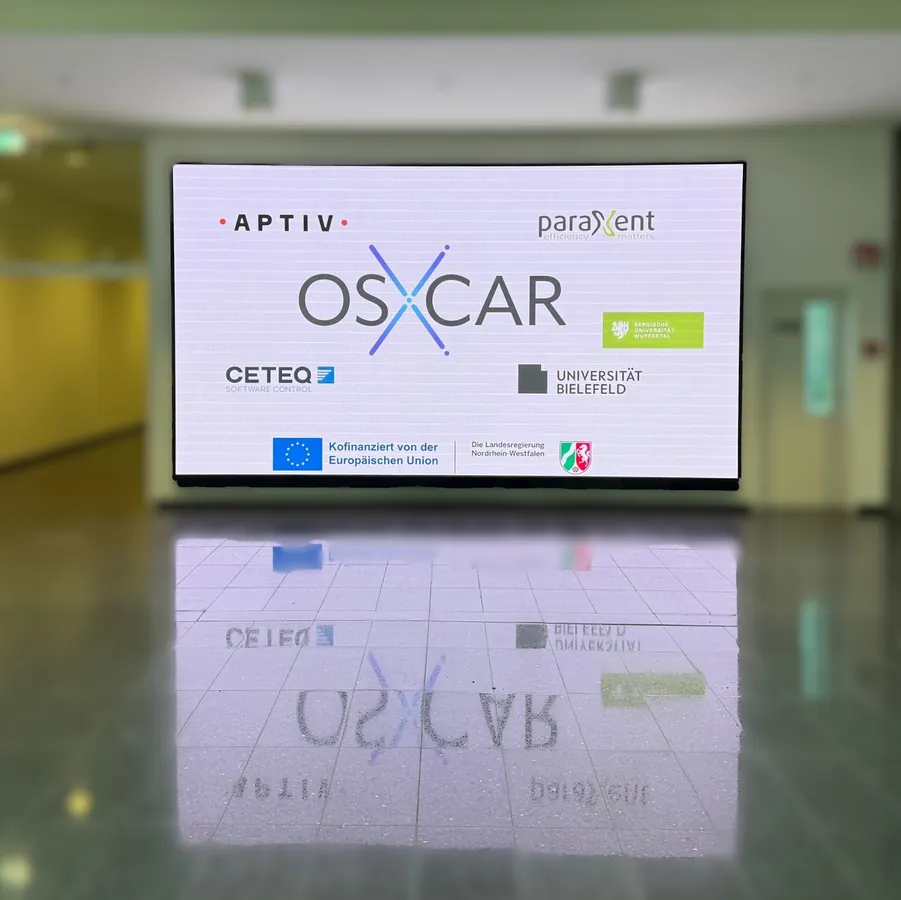
OSxCAR is an ERDF-funded research project (EFRE-20800271, duration 06/2024 – 05/2027). Five partners from industry and academia jointly develop the technological foundation for hardware-independent vehicle software.
🔹 Consortium Lead: Aptiv Services Deutschland GmbH
🔹 Partners: University of Wuppertal, University of Bielefeld, paraXent GmbH, CETEQ GmbH